Launch offer — valid today only

📄 Digital book in PDF · read it on your phone or print it

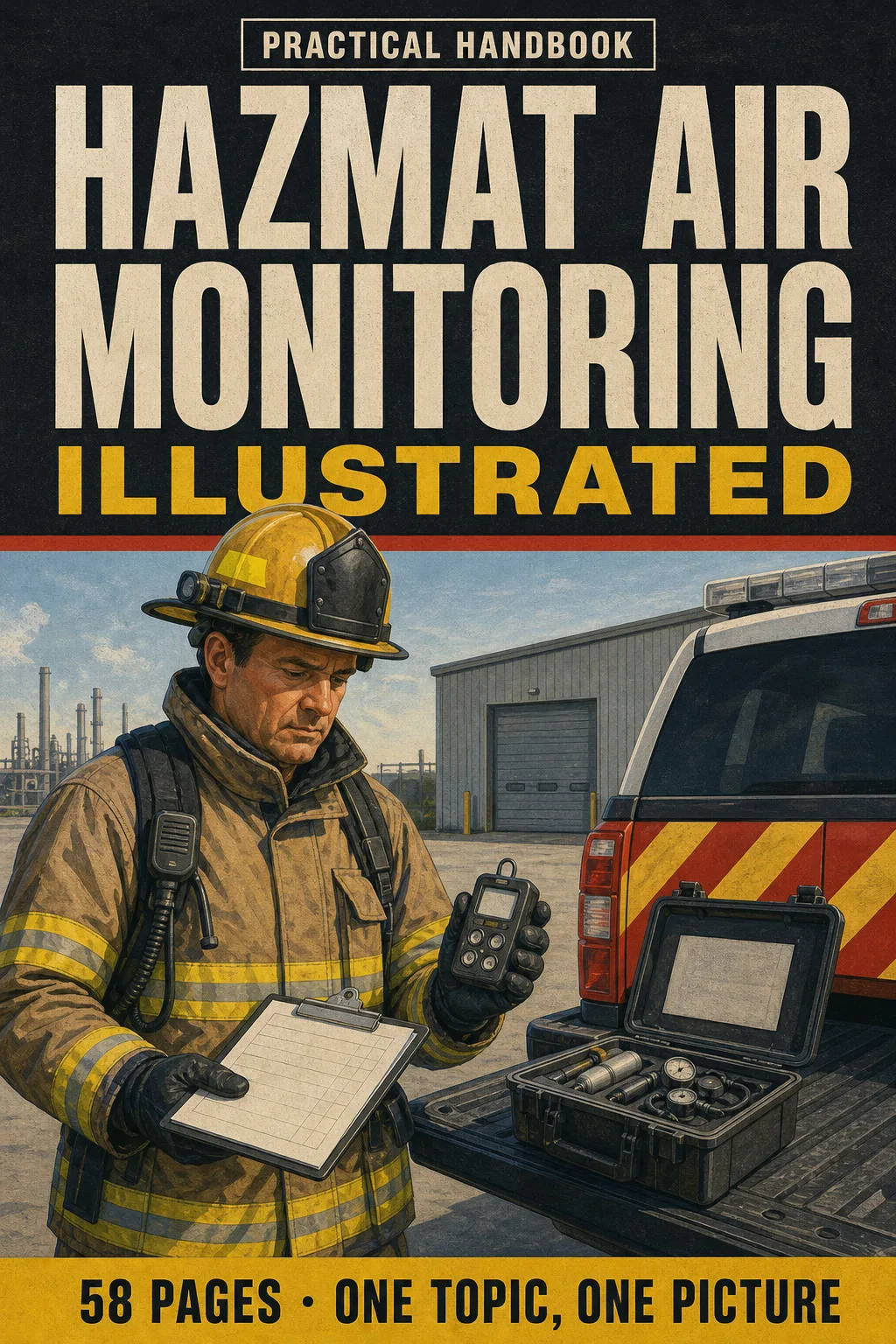
Hazmat Air Monitoring for Firefighters, in Drawings Every Reading in the Same Order

Start-up checks, fresh air zero, bump test, oxygen, LEL, CO and H2S, PID correction factors, colorimetric tubes, vapor density and the radio report. Every topic gets its own page: first the drawing, then what you need to remember. 58 illustrated pages.

START REVIEWING THIS WAY

🔒 Secure checkout · PDF by email · 30-day guarantee

Every topic, its own pageEach meter check and each reading drawn, with the explanation right beside it
58 illustrated pages8 parts, from what the meter answers on a call to ten readings to interpret yourself
Up-to-date sourcesOSHA HAZWOPER, NFPA 470 and the NIOSH Pocket Guide
PDF by emailFormat

Look Inside the Book

Every page has one big drawing and a box with the numbers and steps you need to know:

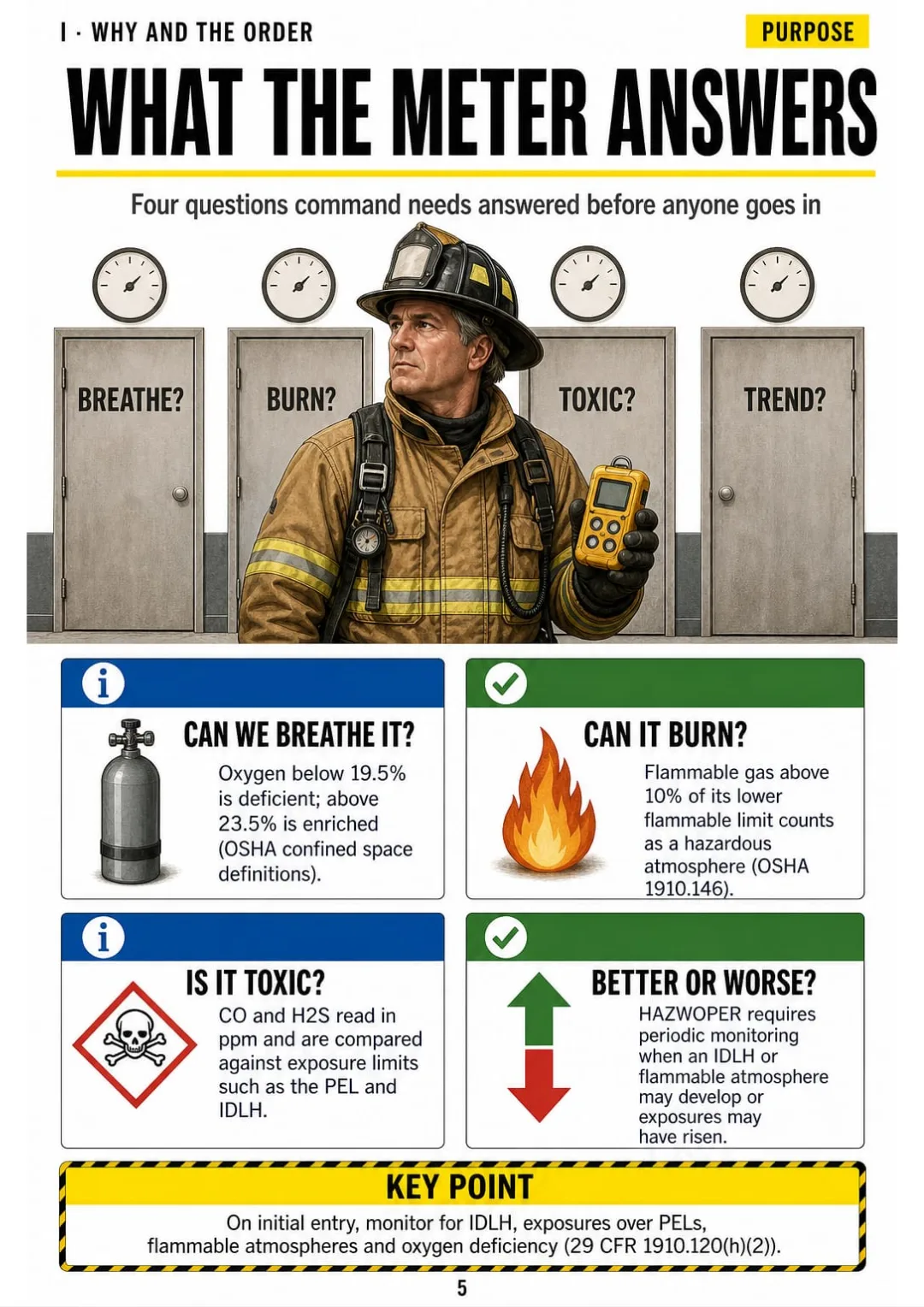
Four questions, four doors: breathe, burn, toxic, trend
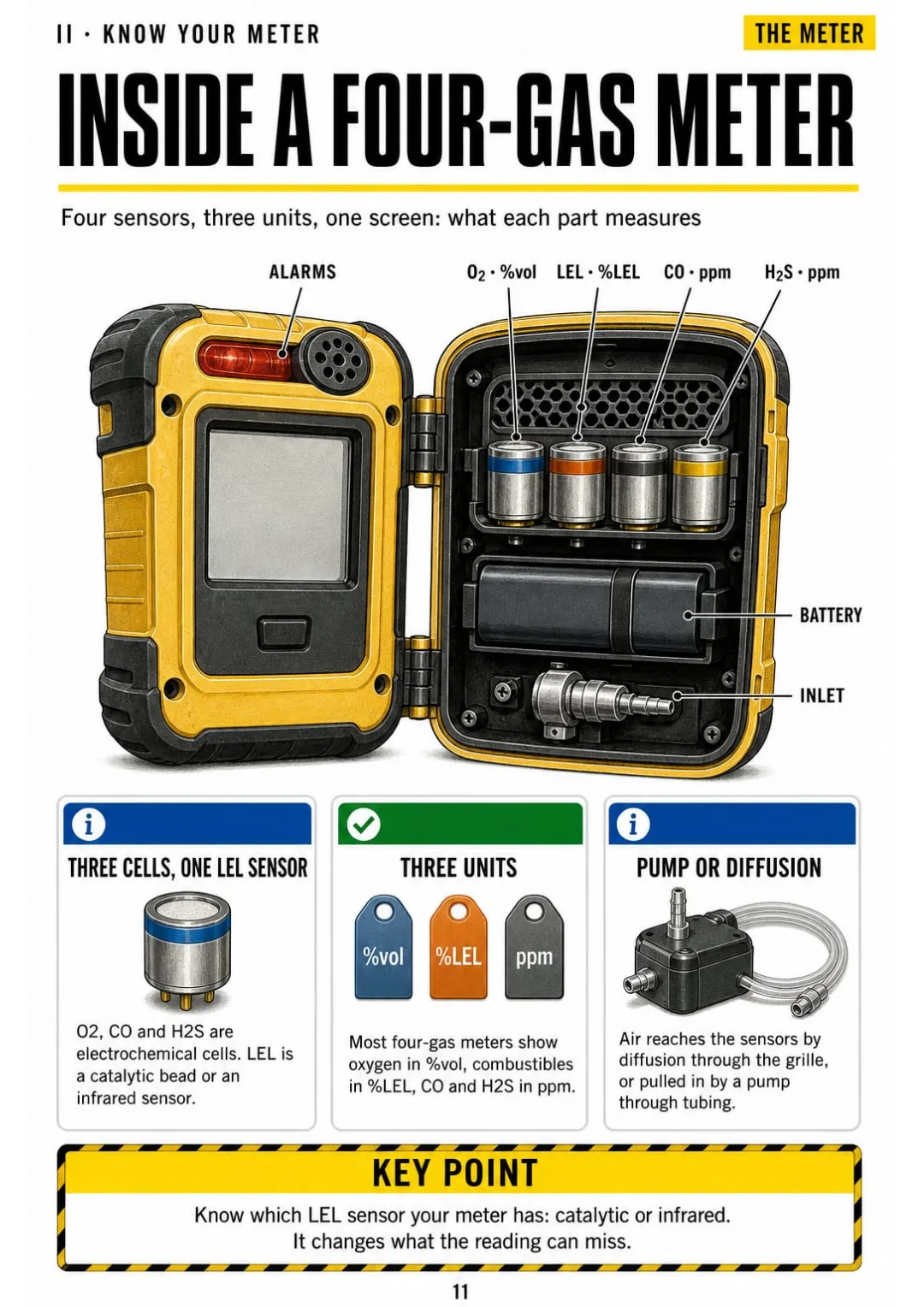
O2 in %vol, LEL in %LEL, CO and H2S in ppm, drawn inside one meter
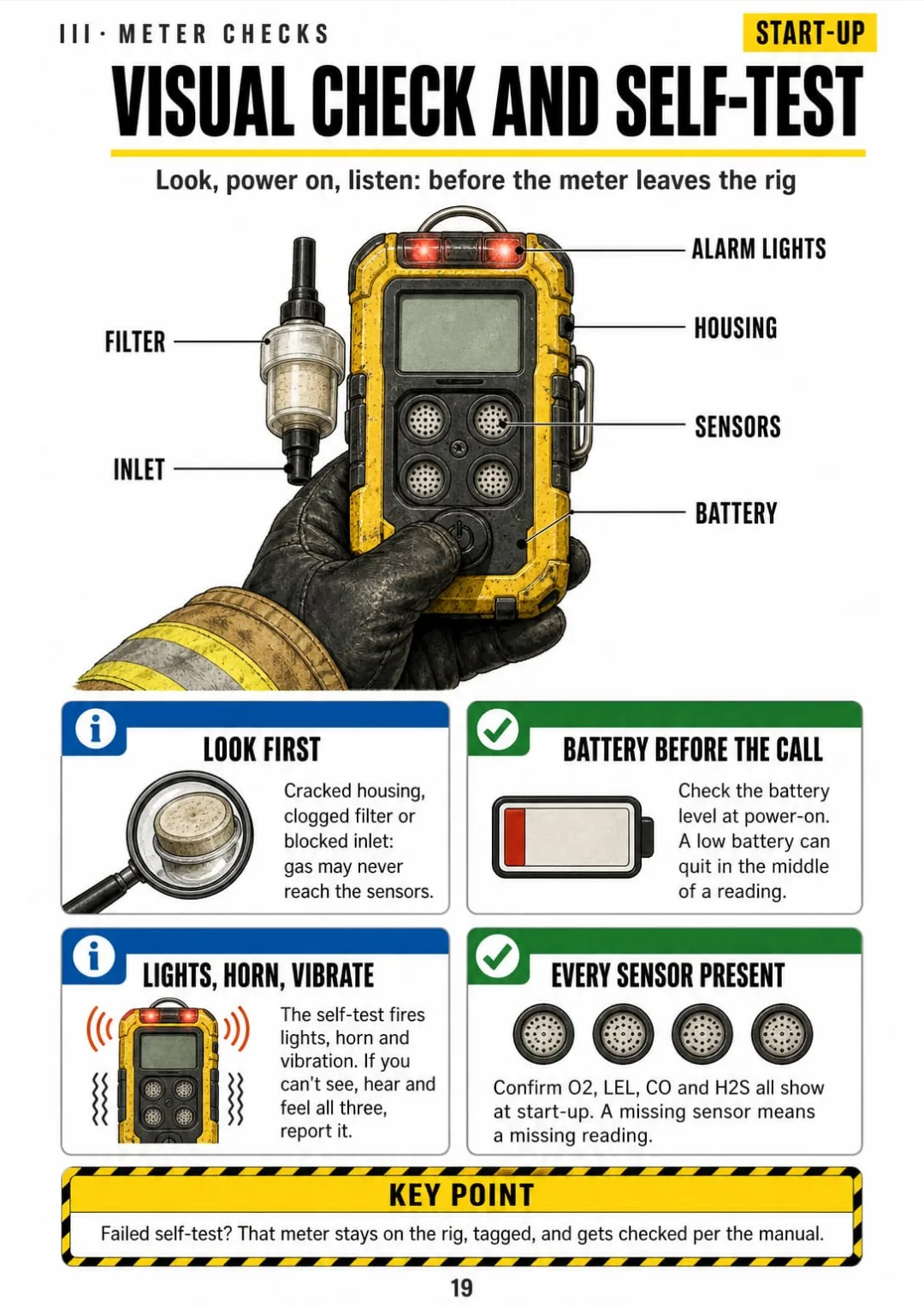
Six things to check at start-up, and why a failed self-test keeps the meter on the rig.
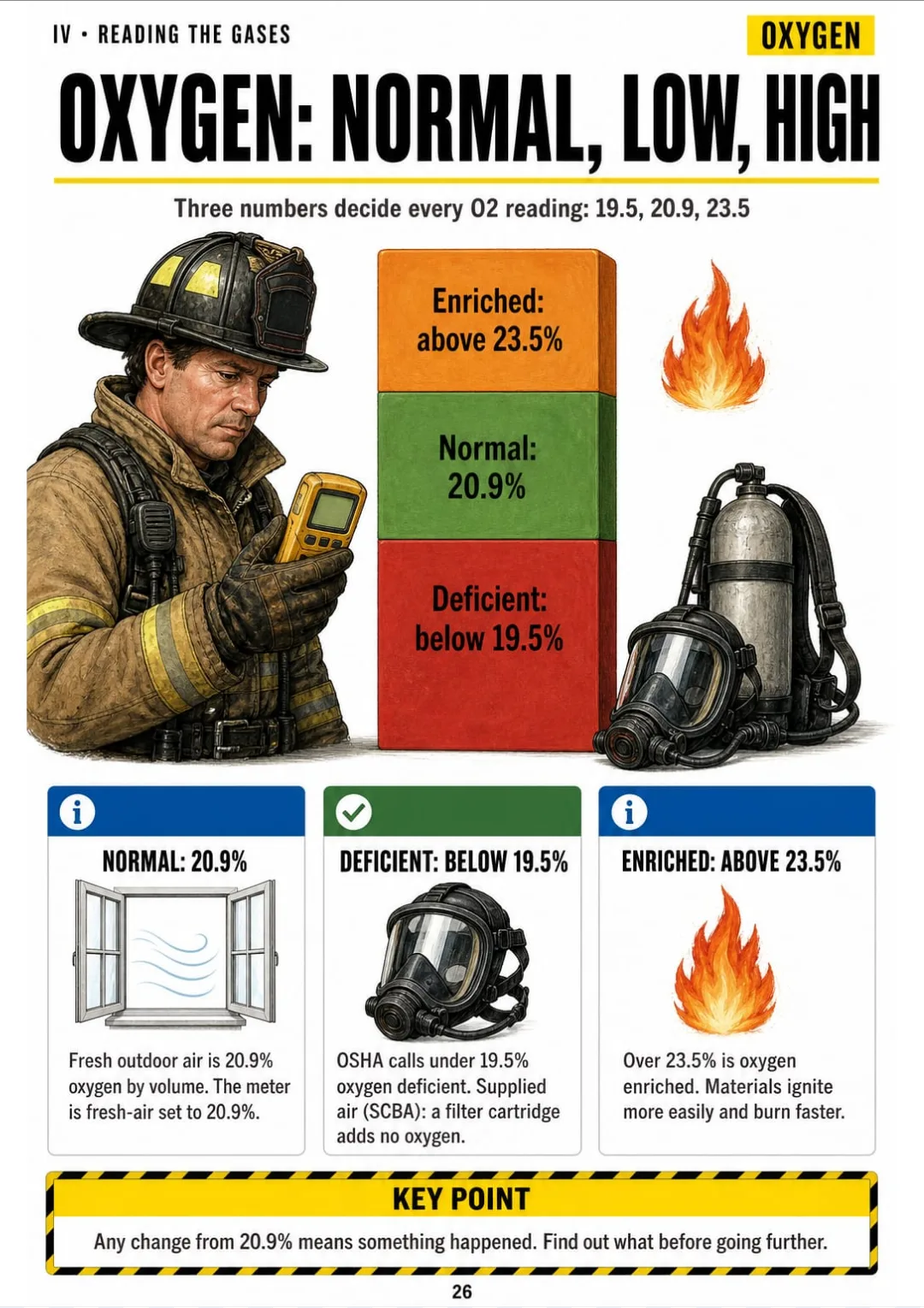
O2: 20.9% normal · below 19.5% deficient · above 23.5% enriched
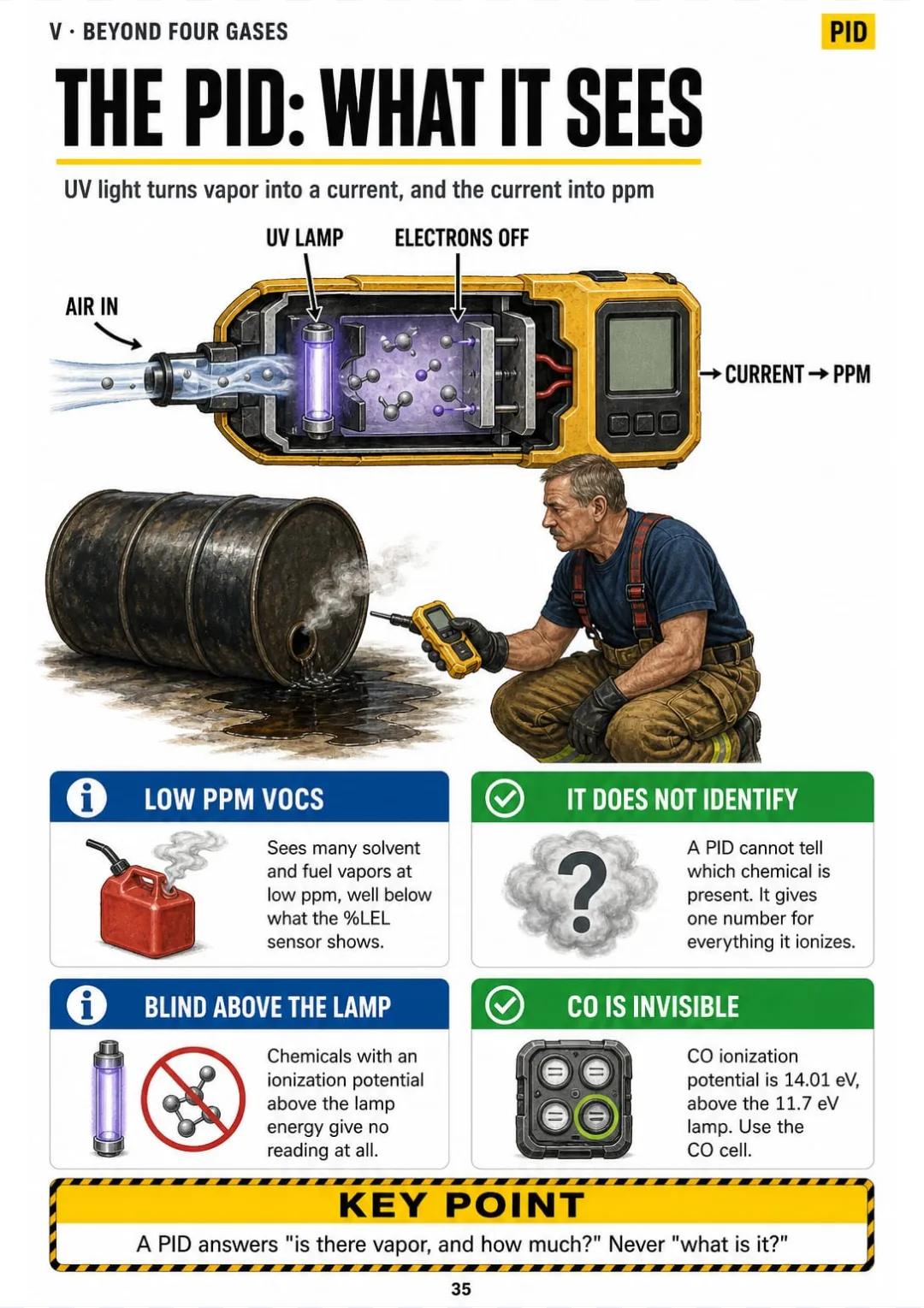
A PID reads many VOCs at low ppm, but CO at 14.01 eV stays invisible.
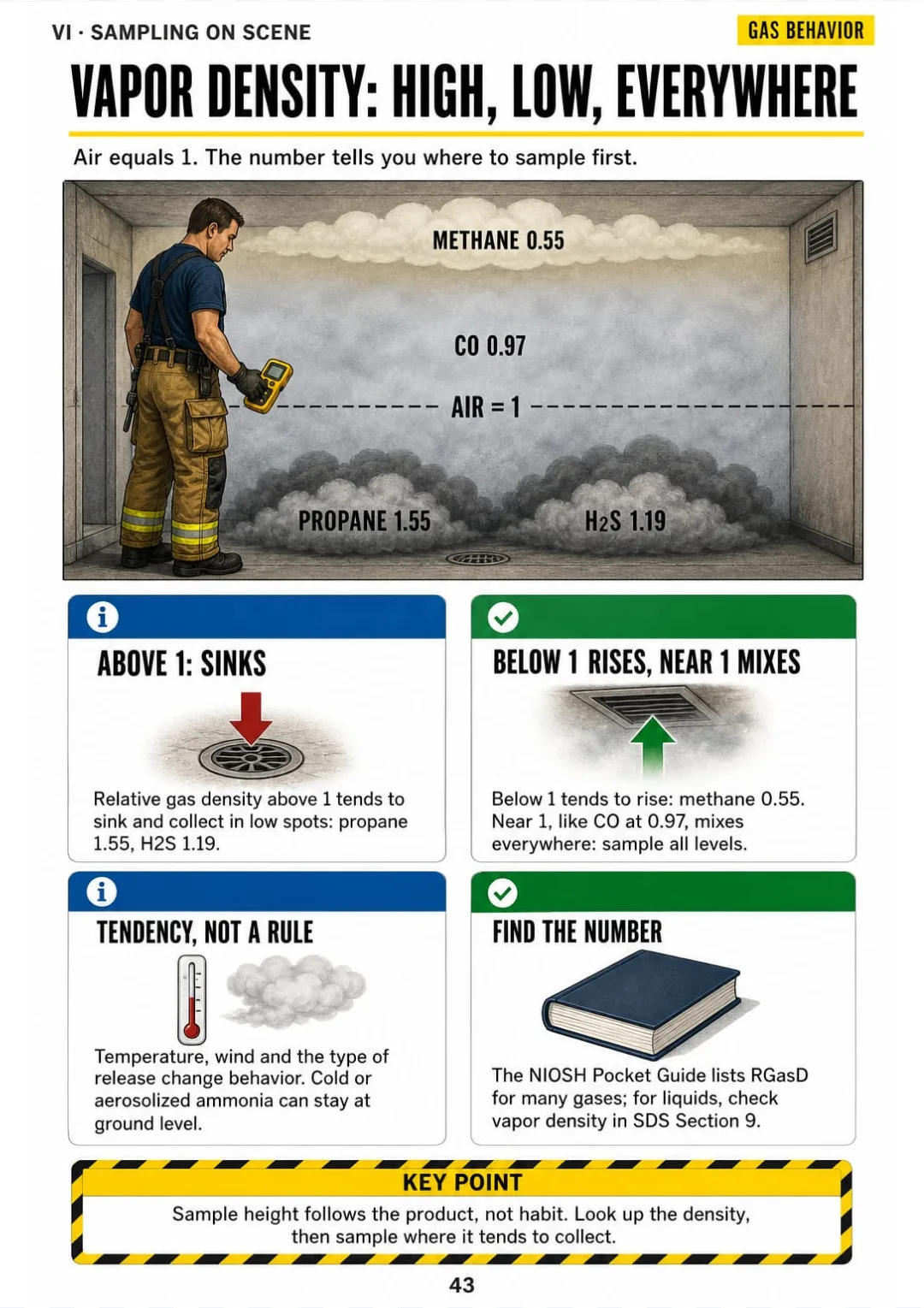
Air = 1: propane 1.55 and H2S 1.19 tend to sink, methane 0.55 rises, CO 0.97 mixes
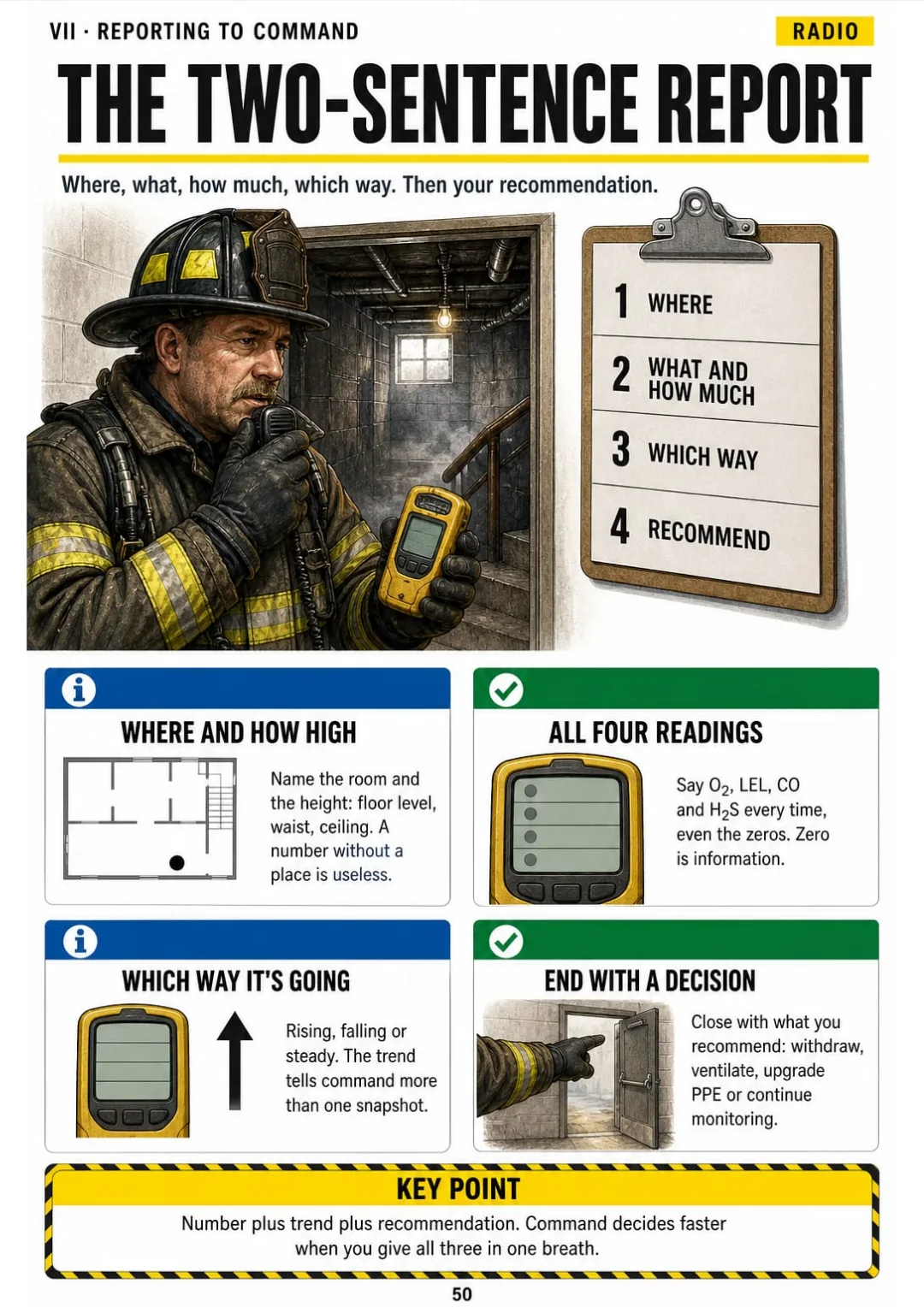
Where, what, how much, which way, plus a recommendation: the radio report in two sentences.
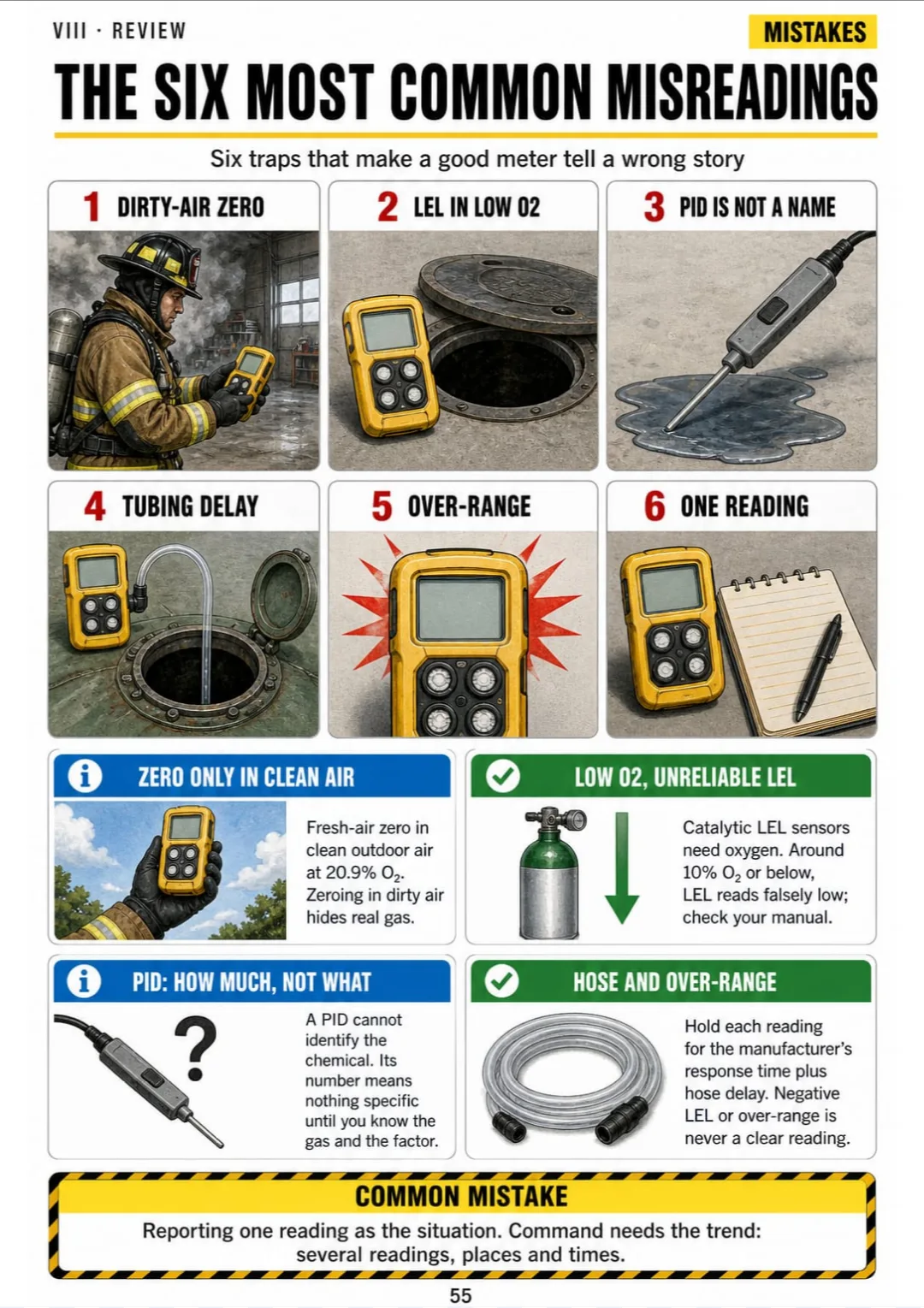
Six traps: dirty-air zero, low-O2 LEL, PID as a name, hose delay, over-range, single reading.

Swipe to see more →

These are real pages from the book. The table of contents is the full one: 8 parts and 54 topics.

The Problem Isn't You. It's How It Was Explained to You.

Start of shift. You power on the four-gas meter, it beeps through the self-test and one line on the screen doesn't look right. The crew is loading up. Does the meter ride or stay?

The manual covers it, somewhere in a dozen paragraphs about sensor faults, battery levels and alarm tests. Nobody reads that standing next to the rig.

Six things to check at start-up, and why a failed self-test keeps the meter on the rig.

In this book, start-up is one page: the meter drawn in the center, the six checks around it, and a box that tells you why a failed self-test keeps it on the rig.

Every other topic works the same way: the fresh air zero, the bump test, low oxygen and the LEL sensor, vapor density, the two-sentence report. Each one has its own page.

You look, you get it, and you run the check without digging the manual out of the cab.

COMPARE FOR YOURSELF

The Same Topic, Two Ways to Study It

THIS
  • The manual: line after line
  • Sensors explained only in words
  • You show up to the call with doubts
The multigas instrument incorporates an electrochemical oxygen sensor, which reports concentration as percent by volume; a catalytic combustion sensor for combustible gases, expressed as a percentage of the lower explosive limit of the calibration gas; and electrochemical toxic cells for carbon monoxide and hydrogen sulfide, expressed in parts per million. Sample delivery may occur by diffusion or by an integral pump. Each sensor exhibits characteristic response times, cross-sensitivities and environmental limitations, which the operator should consider when interpreting displayed values.
FOR THIS
  • The meter's insides in one drawing
  • The units in a box: %vol, %LEL, ppm
  • You see it and you get it
O2 in %vol, LEL in %LEL, CO and H2S in ppm, drawn inside one meter
CONTENTS

Take a Look at the 8 Parts and 54 Topics

Why we monitor, the meter itself, pre-use checks, the four gases, PID, tubes and pH, sampling on scene, reporting to command and a final review: 58 pages, all illustrated.

IWhy We Monitor and the Order · pp. 5-10
  1. What the Meter Answers on a Call
  2. The Five-Step Order: Check, Sample, Read, Trend, Report
  3. Monitoring Priorities: Fire, Oxygen, Toxics
  4. Who Says What: OSHA, NFPA 470, NIOSH, the Manufacturer
  5. Exposure Words: PEL, REL, TLV, STEL, Ceiling, IDLH
  6. %vol, %LEL and ppm: Three Units on One Screen
IIKnow Your Meter · pp. 11-18
  1. Inside a Four-Gas Meter
  2. The Oxygen Sensor
  3. The Catalytic Bead LEL Sensor
  4. Infrared LEL Sensors: What Changes
  5. The CO and H2S Toxic Cells
  6. Pump vs Diffusion Sampling
  7. The Screen: Readings, Peak, STEL, TWA
  8. Alarm Setpoints: Low, High, STEL, TWA
IIIBefore You Go: Meter Checks · pp. 19-25
  1. Visual Check and Power-On Self-Test
  2. Fresh Air Zero: Where and When
  3. Bump Test Step by Step
  4. Full Calibration Step by Step
  5. Reading the Cal Gas Cylinder
  6. Methane or Pentane Calibration: Why It Matters
  7. Failed Bump: What Now
IVReading the Four Gases · pp. 26-34
  1. Oxygen: Normal, Low, High
  2. A Drop in O2 Means Something Else Is There
  3. Low Oxygen Makes the LEL Reading Lie
  4. LEL: What 10% Really Means
  5. LEL Correction Factors: One Worked Example
  6. Over-Range and the Negative LEL Reading
  7. Carbon Monoxide: The Numbers
  8. Hydrogen Sulfide: The Numbers
  9. Reading All Four in the Same Order
VBeyond Four Gases: PID, Tubes, pH · pp. 35-42
  1. The PID: What It Sees
  2. Lamp Energy and Ionization Potential
  3. PID Correction Factors Step by Step
  4. PID Limits: Humidity, Mixtures, Dirty Lamps
  5. Colorimetric Tubes: How to Read Them
  6. Colorimetric Tubes: Cross-Sensitivity and Errors
  7. pH Paper: Corrosive Atmospheres and Liquids
  8. Other Screens: Radiation, Oxidizer, Fluoride
VISampling on Scene · pp. 43-49
  1. Vapor Density: High, Low or Everywhere
  2. Sample High, Middle, Low
  3. Approach Upwind, Uphill, Upstream
  4. Reading Zones on the Incident Map
  5. Confined Spaces and Low Points
  6. Sampling Inside Structures
  7. Watching the Trend
VIIReporting to Command · pp. 50-54
  1. The Two-Sentence Report
  2. Action Levels Made Into Decisions
  3. Writing It Down: The Monitoring Log
  4. After the Call: Clean, Recharge, Re-Bump
  5. Handing Off to the Hazmat Team
VIIIReview and Common Mistakes · pp. 55-58
  1. The Most Common Misreadings
  2. Quick Reference: Action Levels
  3. Pre-Use Checklist for the Rig
  4. Self-Check: Ten Readings to Interpret

One Page, One Topic, All Clear

Think of it this way:

You're in a basement with a gas odor. The meter shows 10% LEL and command wants to know what that means, right now.

You reviewed the LEL page at the station, so you see it again: a gauge from zero to 100% LEL, the alarm points marked on it and the worked example beside it. You answer command in one sentence.

A PID reads many VOCs at low ppm, but CO at 14.01 eV stays invisible.

The same goes for the bump test, low oxygen fooling the LEL sensor, vapor density, PID correction factors and the two-sentence report. Each one on its own page.

Hazmat Air Monitoring Illustrated is 8 parts and 54 topics, all drawn, and it ends with the most common misreadings, a quick reference of action levels and ten readings to interpret yourself.

What you see drawn, you don't have to memorize.

What's Inside Hazmat Air Monitoring Illustrated:

Ipp. 5-10

Why We Monitor and the Order

What the meter answers on a call, the five-step order, fire-oxygen-toxics priorities, who sets the rules, PEL, REL, STEL and IDLH, and three units on one screen.

IIpp. 11-18

Know Your Meter

The inside of a four-gas meter, the oxygen sensor, catalytic bead and infrared LEL sensors, the CO and H2S cells, pump vs diffusion, the screen and the alarm setpoints.

IIIpp. 19-25

Before You Go: Meter Checks

Visual check and self-test, fresh air zero, bump test and full calibration step by step, the cal gas cylinder, methane vs pentane, and what to do after a failed bump.

IVpp. 26-34

Reading the Four Gases

Oxygen normal, low and high, what a drop in O2 tells you, why low O2 fools the LEL sensor, what 10% LEL means, correction factors, over-range, and the CO and H2S numbers.

Vpp. 35-42

Beyond Four Gases: PID, Tubes, pH

What a PID sees, lamp energy and ionization potential, PID correction factors and limits, colorimetric tubes, pH paper and other screens like radiation.

VIpp. 43-49

Sampling on Scene

Vapor density, sampling high, middle and low, the upwind approach, zones on the incident map, confined spaces, structures and watching the trend.

VIIpp. 50-54

Reporting to Command

The two-sentence report, action levels turned into decisions, the monitoring log, after-call care and the handoff to the hazmat team.

VIIIpp. 55-58

Review and Common Mistakes

The most common misreadings, a quick reference of action levels, the pre-use checklist for the rig and ten readings to interpret yourself.

At the end of the book: The most common misreadings, a quick reference of action levels, a pre-use checklist for the rig and ten readings to interpret.
Plus: 2 Free Books

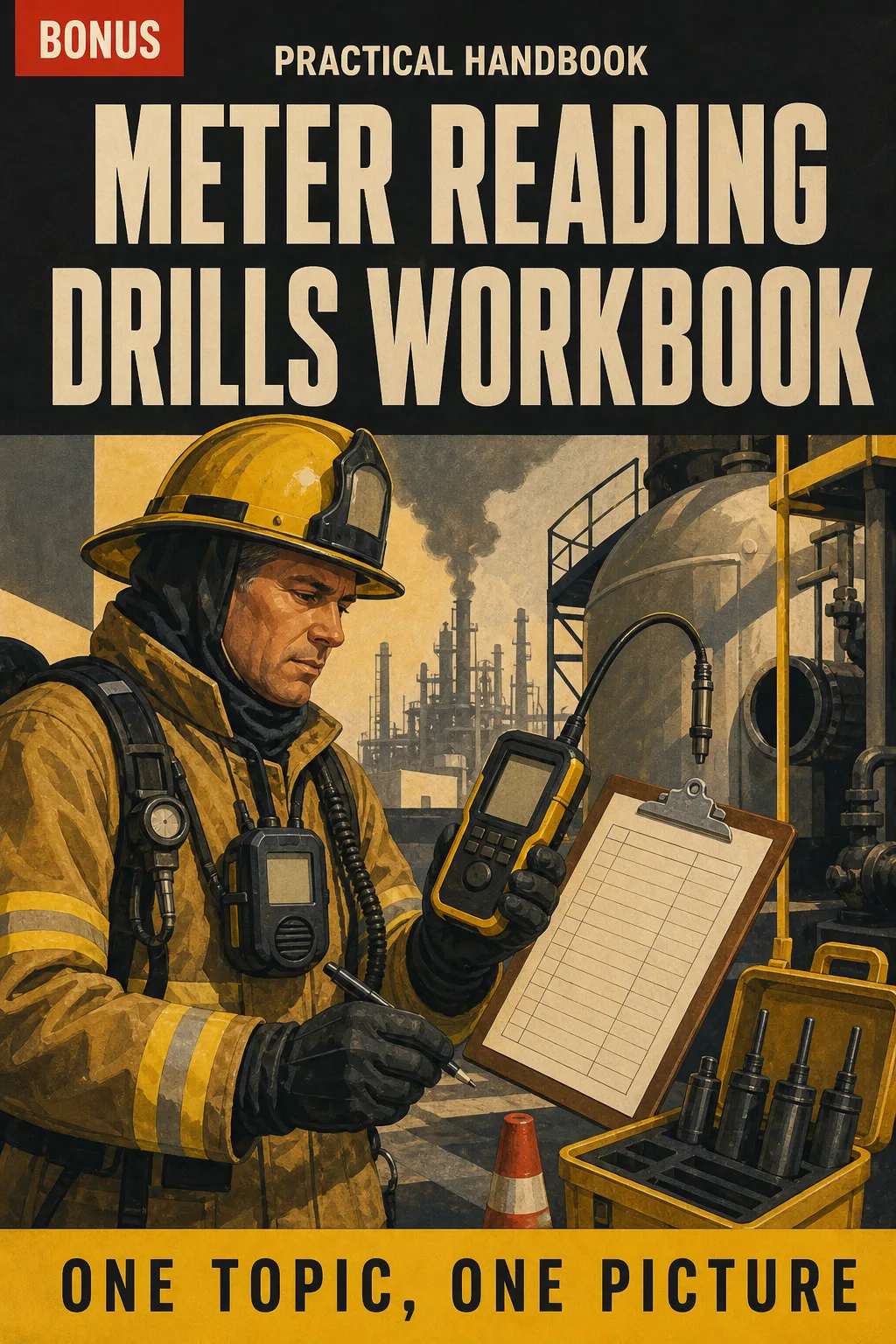
Meter Reading Drills Workbook

BONUS 1: «Meter Reading Drills Workbook»

Value on its own: US$ 17.90

Practice real readings on paper (O2, LEL, CO, H2S, PID with correction factors) so the numbers make sense before you see them on a call.

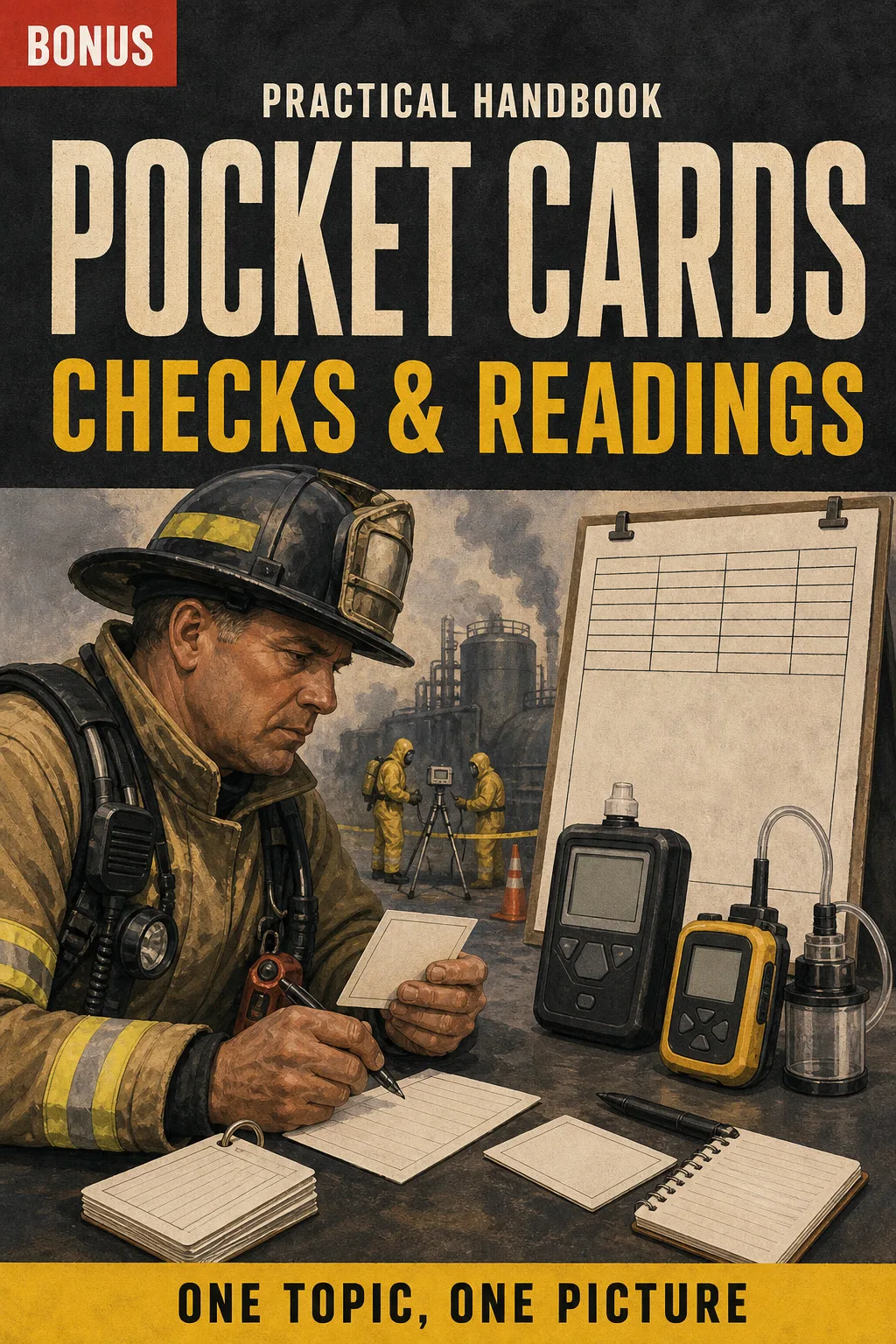
Pocket Cards: Checks & Readings

BONUS 2: «Pocket Cards: Checks & Readings»

Value on its own: US$ 14.90

Printable cards with the before-you-go checks, what each sensor reading means and the most common misreadings, to keep on the rig and review at a glance.

Hazmat Air Monitoring Illustrated with 2 Free Books

  • Hazmat Air Monitoring Illustrated: 58 illustrated pagesUS$ 63
  • BONUS 1: Meter Reading Drills WorkbookUS$ 17.90
  • BONUS 2: Pocket Cards: Checks & ReadingsUS$ 14.90
  • High-resolution PDF to printIncluded
Total value US$ 95.80
YOUR PRICE:
US$ 27
You save US$ 68.80
YES, I WANT HAZMAT AIR MONITORING ILLUSTRATED FOR US$ 27

📄 This is a digital PDF book sent to your email: nothing is printed or shipped.

Secure purchaseEncrypted payment30-day guarantee

PDF by email: We email you Hazmat Air Monitoring Illustrated as a PDF, together with the two free books. It's a single payment: no installments, no extra charges.

Who This Book Is For

You just got handed the meter

You just got handed the meter

The checks, the units and what each sensor reads, one page at a time, so the first call with the meter doesn't feel like guesswork.

Your next drill is coming up

Your next drill is coming up

Review the bump test, the four gases and the radio report in the same order you'll use outside, and print the pages for the station.

You run monitoring on a hazmat team

You run monitoring on a hazmat team

PID correction factors, colorimetric tubes, pH paper and sampling strategy drawn out, to keep on the rig and review at a glance.

Everything You Get Today

US$ 95.80US$ 27
YES, I WANT HAZMAT AIR MONITORING ILLUSTRATED FOR US$ 27

📄 This is a digital PDF book sent to your email: nothing is printed or shipped.

30DAYS
GUARANTEE

30-Day Guarantee

Try Hazmat Air Monitoring Illustrated for 30 days, bonus books included.

We refund everything if the file won't open, if the book isn't what you see here, if you were charged twice or if the email doesn't arrive. Just email us.

You pay once. No subscriptions.

Frequently Asked Questions

Is it for me if I only use the four-gas meter a few times a year?

Yes. It's made for responders with hazmat operations training who pick up the meter after long gaps. It goes by sensor type, not by brand, so it fits most four-gas meters and PIDs. Your manufacturer's manual still sets the alarm values for your unit.

Where does the content come from?

It's checked against current US guidance: OSHA HAZWOPER and confined space rules, NFPA 470, the NIOSH Pocket Guide and OSHA exposure limits. Where your meter's manual or your department's SOPs set different alarm values or action levels, those come first, and the book reminds you to check them on your unit.

Is this official material?

No. It's an independent illustrated study book. It is not affiliated with OSHA, NFPA, NIOSH or any meter manufacturer.

Does it replace my department's training?

No. It's a review tool: it doesn't give a certificate or CE hours. It doesn't replace your hazmat training, your department's SOPs or the instructions for your meter.

Are the practice readings from an official exam?

No. The drills and the ten readings are written for this book. They are not official questions from any exam or certification.

When and how do I get it?

As a PDF by email, sent to the address you enter at checkout. The 2 bonus books come the same way.

Do I have to pay every month?

No. It's a one-time payment. No subscription.

Can I have it on paper?

Yes. The PDF is ready to print, at home or at a print shop, so you can keep it at the station or on the rig.

How does the refund work?

You have 30 days. We refund everything if the file won't open, if the book isn't what you see on this page, if you were charged twice or if the email doesn't arrive: just email us.

Before You Close This Page

No more rereading the meter manual and keeping nothing.

The bump test, the LEL gauge and the oxygen levels: you see them drawn, and that's it.

You get to the call knowing where every number goes.

Drawings make studying faster.

The book is right below.

One-time payment: US$ 27 · Guarantee: 30 days · PDF by email

YES, I WANT HAZMAT AIR MONITORING ILLUSTRATED FOR US$ 27

📄 This is a digital PDF book sent to your email: nothing is printed or shipped.